Cuban President Miguel Díaz-Canel Bermúdez appears before the media this Friday, March 13
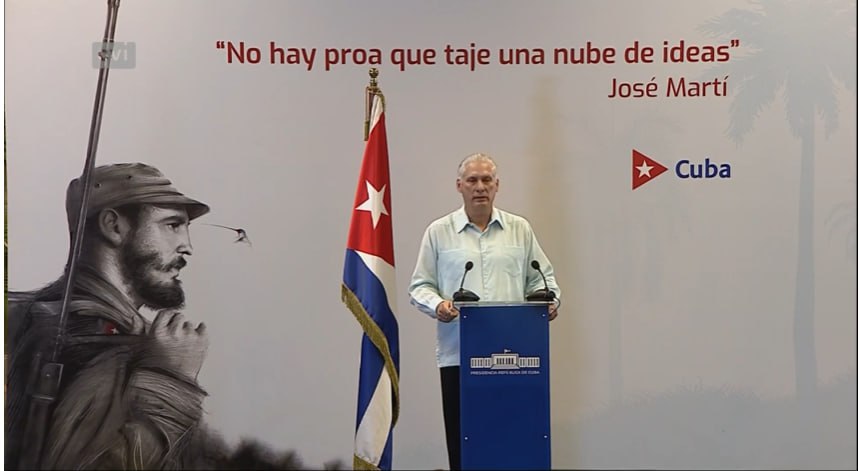
The First Secretary of the Central Committee of the Communist Party and President of the Republic, Miguel Díaz-Canel Bermúdez, appeared before the media this Friday, March 13, 2026, starting at 7:30 a.m., to address national and international affairs.
During his address, broadcast on national radio and television, Díaz-Canel confirmed that Cuban officials have recently held talks with representatives of the United States government. The president explained that these exchanges are part of the consistent policy defended by the Cuban Revolution and are being conducted under the leadership of Army General Raúl Castro, himself, and the highest levels of the Party, State, and Government.
The head of state detailed that the objective of these talks is threefold: first, to identify bilateral problems that require solutions; second, to determine the willingness of both sides to take concrete actions for the benefit of the people of both countries; and finally, to identify areas of cooperation to confront threats and guarantee the security and peace of both nations, as well as in the Latin American and Caribbean region. Díaz-Canel emphasized that these exchanges are taking place within an international context that has facilitated this rapprochement.
In his message, Díaz-Canel emphasized that the Cuban side has expressed its willingness to carry out this process “on the basis of equality and respect for the political systems of both states, for sovereignty, and for the self-determination of our governments,” adhering to international law and with a sense of reciprocity.
The Cuban president described the issue as a “very sensitive process, which is being conducted with seriousness and responsibility because it affects bilateral relations between the two nations,” thus justifying the Revolution’s leadership’s previous silence on “speculative campaigns” regarding these contacts, alluding to press reports that anticipated the negotiations.
He recalled that, historically, in times of tension with the United States, individuals or institutions have emerged to facilitate channels of dialogue, and that in the current situation, such opportunities have also arisen to create spaces for understanding.