Rains ease the situation at the Zaza Dam, but alarms remain raised
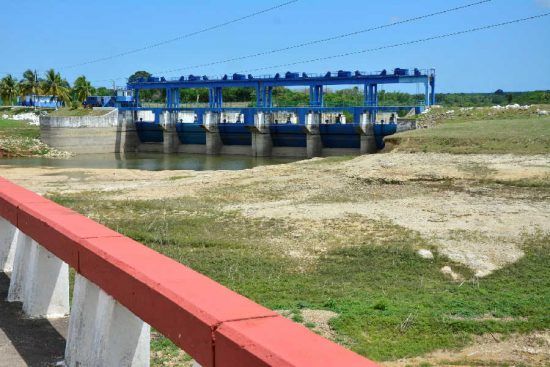
Recent rains have somewhat replenished the reservoirs in Sancti Spíritus. Having taken in nearly 87 million cubic meters over the past 30 days, the Zaza Dam shows a slight recovery in its storage capacity. Today, Cuba’s largest reservoir holds 278.80 million cubic meters of water—30 percent of its total capacity—up from just 21 percent at the beginning of September.
Dixan Ravelo, the provincial delegate for Hydraulic Resources, confirms this. “It has been recovering gradually. It isn’t the volume the dam normally holds at this time of year, but we have seen a slight recovery thanks to the rains that occurred here in the province, mainly at the turn of the month.”
Despite the improvement, concerns regarding the Zaza Dam remain. “A 30 percent level at the Zaza reservoir is still alarming. At this time of year—historically, before 2018 (the last time water was released via the spillway)—we would normally have 800 or 900 million cubic meters. In a season with a significant weather event, we would have released water through the spillway. Still, compared to the 191 million cubic meters recorded at the end of last month, there has been a slight recovery today.”
What will the slight recovery of the Zaza reservoir allow for?
“This will now allow us to make specific adjustments in November for the upcoming season—primarily the rice-growing campaign—to determine the reservoir’s limits and see if we can meet planting demands. We hope the reservoir continues to recover, enabling us to contribute a larger planting volume for the ‘cold season’ that lies ahead.”
Contrary to appearances, the rainfall has not replenished the reservoir as much as it needs. “This is because the rains have been concentrated mostly in the south, meaning there hasn’t been rainfall across the entire watershed that feeds the Zaza reservoir.”
Following the Zaza’s lead, reservoirs in the Sancti Spíritus province took in nearly 95 million cubic meters in a single month. This brings their overall fill level to 36 percent of capacity, creating a favorable situation for the dams that supply water to the population.
“The reservoirs supplying water to the population have maintained a much more favorable status. Lebrije is currently at 42 percent capacity. Tuinucú is above its normal water capacity, and Siguaney is also above its capacity.”