When marijuana stopped seeming dangerous (+ photos)
There is a phrase that Andrés* cannot get out of his head.
He read it written on the wall of the cell where he is being held; while it might have seemed like just another piece of graffiti, it took on a different, personal meaning for him: “Your mother will never betray you.”
He is 27 years old and has been using marijuana for about five years. For much of that time, he was convinced he had the habit under control. A writer and visual artist, he is now awaiting the outcome of criminal proceedings related to the sale of marijuana.
The phrase on the wall made him think of his mother—of the harm this situation had caused her, too—and of the gap between believing one is in control of one’s own behavior and discovering, all too late, that one perhaps never had as much control as one thought.
His story is not unique.
In Sancti Spíritus, an investigation conducted by various units within the Ministry of the Interior (MININT) led to action against several individuals between the ages of 18 and 27. Some remain in custody, classified as both traffickers and users; prosecutors are seeking their pretrial detention on charges of trafficking drugs or substances with similar effects, according to Lieutenant Colonel Rolando Rodríguez Carmenate, head of the Criminal Investigation Department in the province.
The others were identified as users who obtained the substance through the primary defendants.
Most had no prior criminal record and were not connected to any workplace or educational institution. Primarily, they maintained ties to informal cultural projects and, to a lesser extent, to recreational venues within the province.
Yet, behind the official files lie personal stories that cannot be captured in a mere list of detainees, drug users, or defendants.
This report continues a journalistic exploration of the impact of drugs on Cuban society. In a previous installment, *The Abyss of Chemicals* (*El abismo del químico*), we examined other facets of a phenomenon that demands attention, information, and awareness. Now, the stories of these young people offer a closer look at one of its most unsettling contradictions: the point at which drug use ceases to appear as a choice without consequences.
Presented here are four personal accounts that allow us to view the phenomenon from a different angle: How can someone use drugs for months or years—experiencing increasingly severe consequences—while remaining convinced that marijuana is not dangerous?
MORE FUN, BRIGHTER, MORE INTENSE
Daniel** is 22 years old and had been using marijuana for about six years. Daily life seemed boring to him. What began as occasional use gradually turned into a frequent habit.
Later, the substance began to serve a different purpose. “I went through a really tough time, dealing with deep depression and difficult situations, and I started using a lot because it was like an escape,” he confesses.
The frequency increased until marijuana became the focal point of his daily life. He reached a point where he was using it several times a day. He stopped working. He lived on the streets, slept in parks, and at times, his food intake was reduced to almost nothing—just “a peanut bar,” he recalls.
At this stage, the story no longer resembles the initial idea of a substance that simply made life “more intense.”
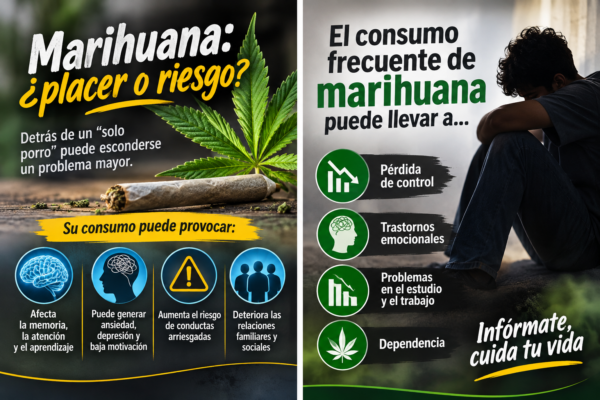
Cannabis use disorder is characterized precisely by the difficulty in controlling one’s use of the substance and by continuing to use it despite the consequences that arise. Signs described in medical literature include failed attempts to quit, an intense craving for the substance, and continued use despite physical, psychological, familial, work-related, or academic problems.
Daniel didn’t need to end up in a hospital to realize that something had changed. His own life became the evidence.
I TRIED IT AND I LIKED IT
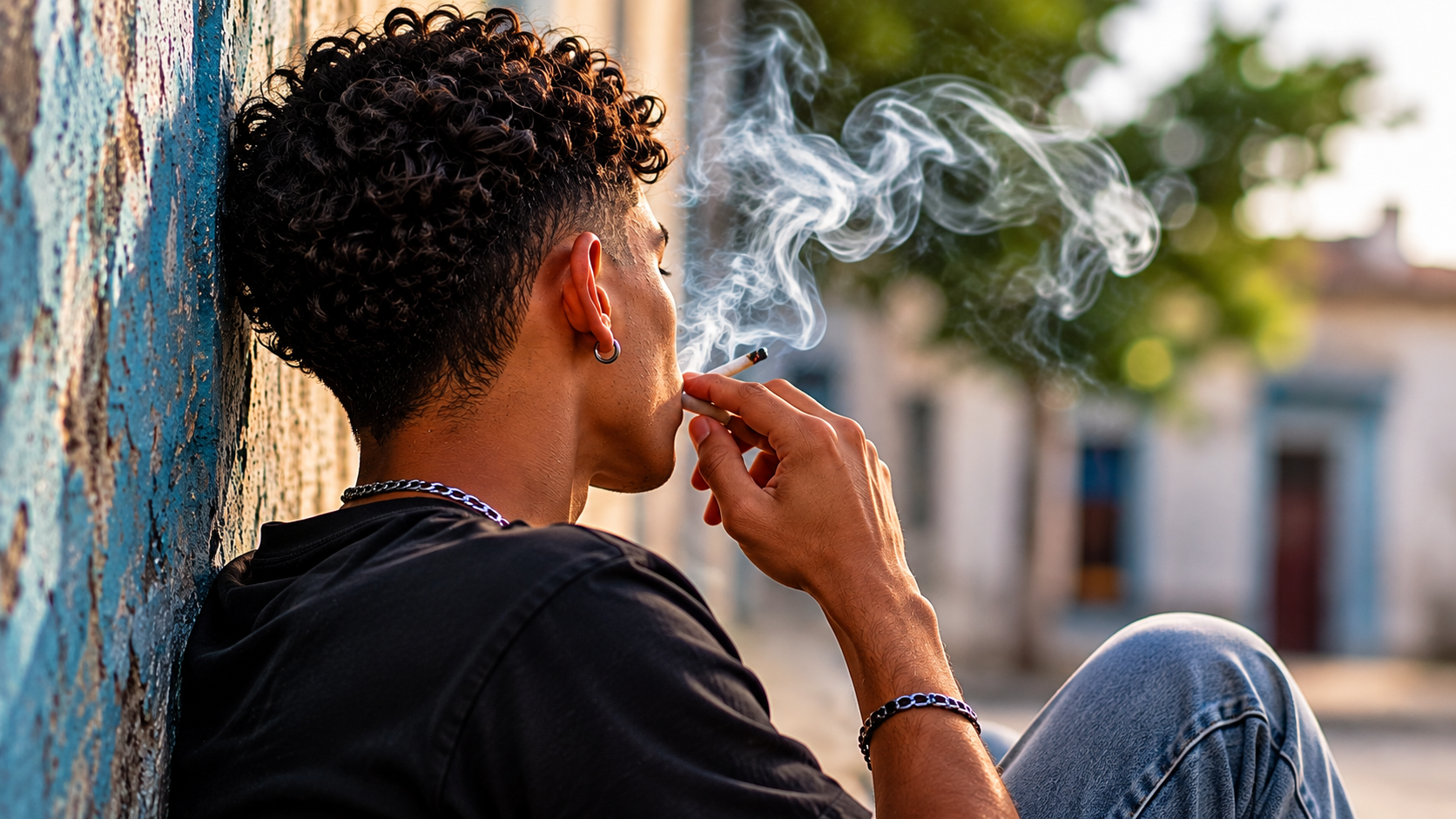
Andrés is an artist, and he tells a different story. He first encountered marijuana in Havana. Someone offered it to him; he tried it and liked it. Afterward, he wanted to repeat the experience.
For years, this logic held, and he eventually began using it daily. He replaced regular cigarettes with marijuana, consuming amounts that far exceeded what he himself considered “occasional” use.
He was also convinced that he had the situation under control—until he didn’t. “Now that I find myself in this situation, I realize that, no—it really wasn’t under control.”
A study published in *Psychopharmacology* examined the effects of various doses of THC on tasks related to creativity. The researchers found no evidence that a low dose increased creativity, and they observed that a high dose could actually impair performance on tests of divergent thinking.
Cannabis acts on the central nervous system and can affect memory, attention, learning, coordination, decision-making, emotions, and reaction time. This risk is particularly significant when use begins during adolescence or young adulthood—stages when the brain is still developing.
MY FRIENDS WERE DOING IT, SO I DID TOO
Luis is 18 years old and still in the twelfth grade.
He wasn’t looking for an artistic experience, nor was he trying to escape depression. “I did it to fit in with the group. My friends were doing it, so I did too,” he says.
The initial impulse seemed simple: a desire to belong. What followed was far more difficult. Two men arrived at his home demanding drugs that were hidden there. They threatened him with a machete and a knife. He thought they might kill him. “I was incredibly nervous at that moment; I didn’t think I’d live to tell the tale,” he recalls.
This incident is also part of a police investigation. According to Lieutenant Colonel Rodríguez Carmenate, two individuals arrived at the home of one of the suspects, threatened him with bladed weapons, and took the drugs. Authorities are currently working to identify and apprehend the alleged perpetrators.
For Luis, that experience shattered his initial perception of what he was doing.
The marijuana he had started using to please a group had placed him in a situation where he feared for his life.
The drug itself hadn’t changed; what had changed was the world that was beginning to form around it.
WHEN USING AND SELLING CEASED TO BE SEPARATE THINGS
Miguel**** is 24 years old and had been using substances for about two years. His story began with tobacco and alcohol. Then came marijuana, following an invitation at a party. First, one experience. Then, another. Later, a deliberate search. Eventually, the use became a daily habit.
Miguel acknowledges that, for a recent period, he was smoking every day. But his account reveals another element that helps in understanding the scale of the phenomenon: the money he used to acquire the drug came, in part, from the sale of marijuana itself.
The line between consuming and selling began to blur.
A person who initially needs money to buy a substance may end up finding, in the substance itself, a way to obtain that money. Thus, a consumer can become a seller, and a seller can remain a consumer.
Miguel is currently going through a period of abstinence. Stopping or significantly reducing regular cannabis use can lead to anxiety, irritability, sleep disturbances, loss of appetite, and mood swings—symptoms that typically appear within the first few days and can persist for weeks in heavy users.
For someone who, for months, organized part of their life around the substance, quitting is not simply a matter of deciding not to smoke. It means learning to live without a routine that had become deeply embedded in their daily life.
A TOXICOLOGIST’S PERSPECTIVE
Dr. Yaneisy Valdés Gutiérrez, a specialist in General Medicine and Toxicology and director of the Camilo Cienfuegos Provincial General Hospital in Sancti Spíritus, has had direct contact with the young people involved in this case.
Her observations help provide a medical term for a contradiction that appears repeatedly in their accounts.
Several of these young people, she explains, do not recognize the harm associated with their consumption. Some have been using the substance systematically for years, yet they continue to interpret the sensations—which are actually part of the substance’s psychoactive effect—as beneficial.
“Marijuana contains THC, the primary psychoactive component of cannabis, which can alter perception and various functions of the central nervous system. It can produce euphoria, relaxation, an increased appetite, and changes in sensory perception. Some users describe seeing more vivid colors, experiencing more intense flavors, or feeling a greater sense of creativity,” she explains.
However, experiencing pleasure does not mean one is out of danger. “This does not mean that it isn’t causing damage to your internal organs. It certainly is,” warns Valdés Gutiérrez.
The specialist points to potential health issues affecting the respiratory, cardiovascular, central nervous, digestive, and genitourinary systems, as well as specific risks in certain circumstances, such as during pregnancy.
She also draws attention to the consequences of long-term use and the potential for developing dependency. The World Health Organization has noted that cannabis is the most widely consumed psychoactive substance subject to international control, and that its non-medical use can lead to adverse health and social consequences, including disorders related to its consumption.
WHEN THE BODY CONTRADICTS PERCEPTION
Miguel’s experience offers a concrete answer to this contradiction. For a time, he could smoke and feel good. Now, when he doesn’t smoke, his body demands something else.
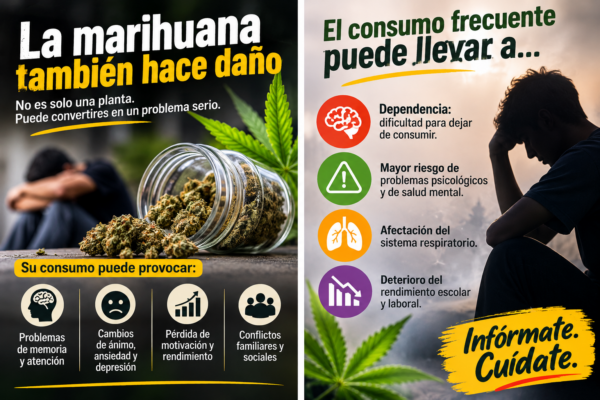
Withdrawal introduces a dimension that is absent during one’s initial encounters with the drug. At first, relaxation may be the dominant effect. With frequent use, tolerance and dependence can develop. And when consumption stops, unpleasant symptoms emerge.
Dr. Valdés Gutiérrez notes that she has observed manifestations such as anxiety, sleep disturbances, loss of appetite, sweating, and significant shifts in emotional state.
In more complex cases, she warns of the need to monitor for the onset of depressive symptoms and even suicidal ideation. Not every user will develop a severe withdrawal syndrome; however, its very existence challenges the notion that cannabis is a substance that simply “relaxes.”
THE FAMILY LEFT BEHIND
In all four accounts, the family appears—to varying degrees—not as the sole explanation for the drug use, but as part of the context in which it unfolds.
Daniel lost his father when he was around 15 years old. Over time, his relationship with his mother deteriorated. His family remained in Las Tunas, and upon arriving in Sancti Spíritus, he did not find a sufficiently strong support network.
His grandmother helped him with food, but there were times when he was essentially on his own. He even considered returning to Las Tunas.
The toxicologist has observed similar situations among young people receiving care in the province: parents living abroad, youths left to fend for themselves, family difficulties, and a lack of adequate day-to-day guardianship.
However, she offers an important clarification.
While such circumstances may contribute to vulnerability, they do not automatically explain the situation. A fractured family does not, by itself, turn someone into a drug user. Likewise, not all young people who live apart from their parents end up using drugs.
A CHAIN THAT DID NOT END WITH THE SELLER
An investigation by the Ministry of the Interior (Minint) in the province made it possible to reconstruct part of the route the marijuana took to reach Sancti Spíritus. According to Rodríguez Carmenate, three of the primary suspects transported the substance from Las Tunas inside deodorant containers, which they had tampered with in an attempt to evade detection by police dogs during searches.
Two of the individuals resided in that province, while a third lived in Trinidad. “The investigation established that the drugs were acquired in specific neighborhoods in Las Tunas and subsequently transported to Sancti Spíritus, where small-scale distribution points would then emerge,” the Minint official explains.
The substance reached buyers and consumers. Consumption took place in private homes, recreational centers, and other spaces frequented by young people. In some accounts, the act of selling served as a way to finance one’s own consumption. In others, it represented a role within a supply chain that began much earlier—with those who sourced the drugs from outside the province.
Ultimately, the clandestine market was fueled by its own consumers, some of whom ended up becoming part of that very market.
THE PHRASE ON THE WALL
Perhaps this is the question that remains unanswered when the case concludes: At what point does an experience that once seemed harmless begin to dictate the life of the person consuming it?
The answer does not always lie in the very first joint.
It may emerge much later: when quitting is no longer easy, when the drug begins to demand money, when conflicts arise, when the body reacts to its absence, or when a person discovers that what they thought they had under control was, in fact, shaping their decisions.
Andrés looks back at the phrase on the wall: “Your mother will never betray you.” Perhaps the real problem in this story is something else: for far too long, they, too, did not believe that marijuana could ever betray them.
*, **, ***, **** The names of the four young people featured in this report have been changed to protect their identities. The accounts are based on interviews given voluntarily to the author.