Díaz-Canel on “Shared Criteria”: Responding to the people with actions, not rhetoric
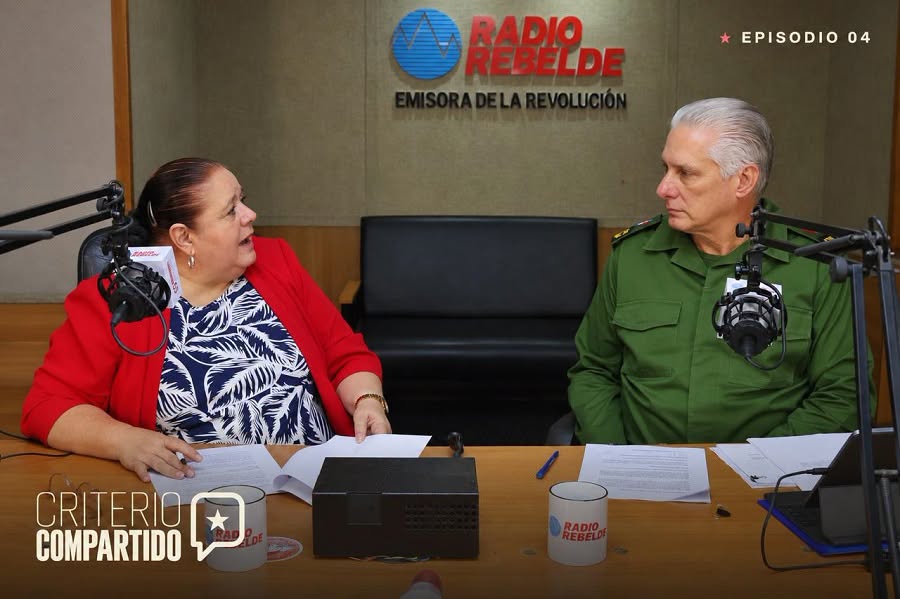
Difficulties with water supply, the impact of power outages, and the accountability of institutions in addressing citizens’ grievances were the focus of the fourth installment of *Criterio Compartido* (“Shared Criteria”), broadcast on November 4 via Radio Rebelde. The program was hosted by Bárbara Betancourt and featured the participation of Miguel Díaz-Canel Bermúdez, First Secretary of the Central Committee of the Communist Party of Cuba and President of the Republic.
The President acknowledged the severity of a situation that affects the daily lives of families, urging that investments and technical solutions be combined with consistent, empathetic, and responsible attention toward the public.
Raising concerns is a right; responding is a duty.
Díaz-Canel highlighted the respectful manner in which people express their concerns—even after enduring long periods without water—and emphasized that those who reach out to the program are exercising a fundamental right.
“They are exercising their right to voice their concerns, and it is our duty to listen with humility and to respond with concrete actions rather than rhetoric,” he asserted.
In examining the root causes, he pointed to aging infrastructure, the inability to carry out necessary investments and maintenance, the consequences of the blockade, and the shortages of fuel and electricity required to keep water-pumping systems operational.
He acknowledged that the problem “is real, serious, and complex,” explaining that a solution requires a comprehensive program and time to implement the necessary investments.
“The public is not a nuisance”
The President insisted that material difficulties cannot serve as a justification for a lack of attention, delayed responses, or the absence of officials in affected areas.
“Nor will we dwell on external causes to justify a lack of institutional response,” he stated.
In light of accounts from communities left without any explanation, he urged officials to listen, visit, share the situation with local residents, and seek alternatives. He also called for accountability in cases involving negligence, indifference, or mistreatment.
“The public is not a nuisance; they are the very reason our institutions exist.”
During the discussion, concerns were also raised regarding the theft of pipes and the unauthorized tampering with valves. Díaz-Canel emphasized the importance of heeding warnings from residents and considering their proposals to prevent the recurrence of problems they had already pointed out.
Six months of silence—and a solution that could have been implemented in a matter of hours.
One of the cases analyzed involved a resident of Mantilla, in the Arroyo Naranjo municipality, who reported having gone more than six months without receiving the usual level of service—and without obtaining any answers from the authorities she had approached.
In assessing the situation, Díaz-Canel noted that an investigation revealed issues with the valves, for which a technical solution existed that could have been implemented in a matter of hours. He described the six-month lack of response as an institutional failure.
“Six months of silence cannot be justified by any technical complexity. Technical challenges may exist, but silence is inexcusable.”
This case underscored the necessity of visiting communities, verifying the actual situation, and coordinating the efforts of those responsible for finding solutions.
Addressing issues cannot depend on reaching out via radio.
The President cautioned that the institutional response must also extend to those who do not call in, are unable to get through, or cannot listen to the program.
“Addressing a case and finding a solution cannot depend on an individual’s media visibility.”
He explained that the *Criterio Compartido* (Shared Criteria) initiative should help foster an approach based on listening, conducting site visits, evaluating situations, seeking solutions, and embracing the role of public servants. Addressing people’s concerns, he emphasized, is a permanent institutional duty.
More than 2.6 million people affected by piped water service
During his remarks, the president of the National Institute of Hydraulic Resources, Antonio Rodríguez, reported that as of the morning prior to the broadcast, 2,681,770 inhabitants were experiencing disruptions to their piped water supply.
He explained that 66% of these disruptions were linked to electrical power issues, while 25% were due to problems with pumping equipment. In Havana, 536,000 people were reported to be affected.
In analyzing distribution alternatives, Díaz-Canel acknowledged the usefulness of water tanker trucks for addressing emergencies, but cautioned about their limitations—noting that they, too, are dependent on fuel.
“We are not going to solve the problem with tanker trucks; they only help to mitigate it.”
Consequently, he emphasized the need to restore water networks and pumping systems, as well as to make the necessary investments to reach communities that have historically relied on this type of distribution.
Distinguishing between power outages and water supply disruptions
Díaz-Canel explained that one of the goals of the comprehensive program is to reduce the water supply’s dependence on the status of the National Electric Power System.
Summarizing the priorities, he identified three pillars:
Restoring water supply sources and main transmission pipelines.
Advance the energy transition by incorporating renewable energy sources into pumping systems, including primary and intermediate pumping stations.
Strengthen institutional management and the systematic provision of services to the population.
Regarding investments, Antonio Rodríguez reported on the construction of 10 solar farms—with a combined capacity of 200 megawatts plus storage—intended to supply three key water sources for Havana. He noted that their completion is scheduled for August 2027, though efforts are underway to shorten this timeline.
He also reported that 853 pumping units are currently in operation as part of the shift in the energy matrix, and announced that an additional 446 units are expected to arrive before the end of December this year.
The President clarified that these are large-scale investments requiring time, even as immediate challenges regarding service delivery are being addressed.