Have prices spiraled out of control?
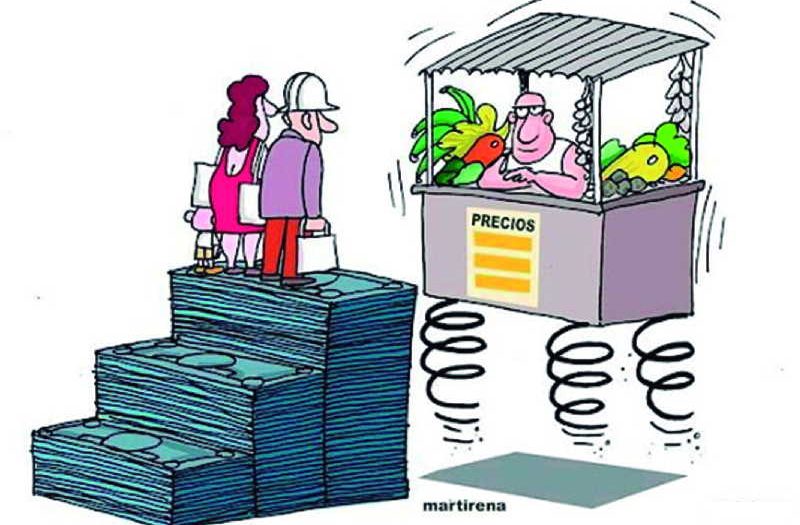
Ever since the price of a pound of lard—at 1,800 pesos—surpassed that of its “mainstay,” meat, prices have entered a whole new dimension: one that is insane and surreal.
Were it not for the fact that this is—unfortunately—not an isolated case, and a reality felt tangibly every day (even in one’s stomach), it would seem almost unreal.
But it is real. Prices have skyrocketed so sharply in recent months that the phenomenon cuts deeper than the public outcry and the labels used to describe them—high, speculative, abusive—which now seem woefully inadequate.
And while this upward spiral has been evident for years, the tendency for prices to jump in the blink of an eye—with a product costing one amount in the morning and another in the afternoon—has intensified following one of the more than 170 measures announced by the country two months ago.
That measure articulated the intention to set prices more in line with market forces—supply and demand—even though the specific legal regulations to implement this are still lacking. Strictly speaking, the only actual legal change was the repeal of the resolution that set price caps on various essential goods—such as chicken, cooking oil, and sausages—in order to adjust them somewhat to current realities.
The issue is that, between the measure’s enactment in early 2025 and today, most food products in Cuba have shifted into the “high-demand” category—since they were already “essential goods”—meaning the list of price-capped items would effectively become limitless.
Staples—such as rice, sugar, beans, eggs, meat, and cooking oil—have vanished from the state distribution network, let alone the rationed family basket. To find them—and, in fact, to eat and survive—people must buy from private vendors, who are also the source for soap, detergent, charcoal, and more.
The objective conditions driving the “madness” of prices—the tightening of the comprehensive U.S. embargo against Cuba, shortages of all kinds, low productivity—were already severe; all that was needed to push the situation completely out of control was a state directive like the one described in the new market regulations.
If even the 2025 regulations failed to ensure full compliance—with only a few vendors selling oil at the 990 price point, for instance—how can we expect anyone to sell at lower rates now? We are facing acute shortages, a generalized crisis, and a state-sanctioned “license” allowing vendors to set whatever prices they please.
The comprehensive inspection drive currently underway in the province aims to curb abusive pricing. However, given the current reality—and I repeat, following a state directive that essentially authorizes everyone to sell at whatever price they damn well please—this effort remains subjective and open to debate.
Yet, as almost always happens when such measures are introduced, the products are effectively hidden and sold through back-channel deals—under the table, via social media networks, and so on—at higher prices, naturally.
Oversight measures can do little against a trend that has come into vogue: setting two different prices for the same product—one for cash and another, even higher, for digital transfers.
“What is to be done?” ask many who have been fleeced by prices that have spiraled out of control. Some have welcomed the price caps implemented in other provinces, even though such measures seemingly contradict the guidelines set out in the 176 measures regarding market pricing.
As far as we know, this province has not followed that trend; instead, it has opted for a comprehensive enforcement effort that has resulted in dozens of fines—some of them massive—levied against those proven to be engaging in price gouging. What is known, however, is that many of the products subject to price caps in those other regions vanished from store shelves and were even trafficked to other territories, fueling the sort of “national resale frenzy” that Cuba has become.
According to those involved in this enforcement effort, the rule is that economic actors—including state-run entities—are permitted a profit margin of up to thirty percent above product costs. The notion is nothing short of laughable and paranoid. Let me give you a ready example: liquid detergent sold in some shops in Sancti Spíritus for 170 pesos is resold at various locations—including on the street—for 350 pesos.
Economists agree that the most effective way to regulate and lower prices is through production and an abundant supply. Given that perspective—and the fact that the state enterprise sector is in a slump—there is little hope that this rule will actually be observed. Take the case of eggs, for instance: the Sancti Spíritus Poultry Enterprise, which just a few years ago boasted a flock of some 300,000 hens, is now left with fewer than 5,000; many died from a lack of feed, despite the sector’s attempts to implement various production formulas. Can anyone realistically expect the price of eggs to drop below the 150-plus pesos they currently command?
Many understand that the prices of certain products are rising due to reports about some 7,000 containers stranded in ports around the world—held up by U.S. coercive measures—which are presumed to carry merchandise belonging to various economic actors.
Yet, a nagging question arises: if neither the uniform shirts nor the lard were in those containers, why do the shirts cost over 1,500, and why does the price of lard go up daily?
This is a puzzle for economists and government officials to solve—much like the unexplained phenomenon of rising prices occurring even while the dollar remains on a plateau (albeit a high one) and serves as the basis for nearly all commercial exchange in Cuba.
What is clear, however, is that rampant inflation and its domino effect seem to rule this “law of the jungle,” where some would rather let their goods spoil than lower the price by a single cent. But if that were to change, other things—and not just prices—might well spin out of control.