The Man who Returned to the Lions
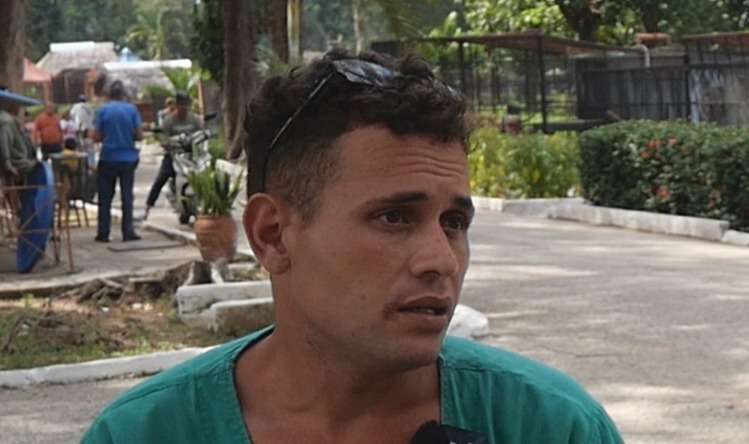
Some stories seem straight out of a movie script because they contain the kind of plot twists that, in fiction, would make the audience wonder if such events could truly happen. Eduardo Antonio González Hernández’s story has precisely that quality—except there were no actors, special effects, or pre-written scenes here: there was only a 23-year-old veterinarian, a loose lion, and mere seconds to choose between the instinct to survive and the power of an animal capable of killing with a single bite.
It happened two years ago at the Ciego de Ávila zoo, where Eduardo had just begun his professional career after graduating as a veterinarian. That morning, he arrived—as he had so many times before—at the spot where he usually changed clothes before starting his shift and preparing to tend to the animals. It was a familiar, oft-repeated routine—the kind that, precisely because of its everyday nature, ends up stripping a place of any appearance of danger.
Near the lion enclosure, there were some small crocodiles that had been brought there for protection. The area had a specific layout: two cages facing each other, an access gate, and a corridor behind them used by the staff.
Eduardo knew the setting perfectly and entered without suspecting that several acts of negligence committed the previous day had disrupted the place’s perfect order.
He opened the door as usual, ready to step inside and get back to work. But just as he was about to close it, the animal appeared from below. It had been lying in wait, watching him.
The young man hadn’t seen it. The lion, however, had seen him. “It was watching me the whole time,” says Eduardo.
As it turned out, the difference between those two perspectives would prove decisive.
WHEN ROUTINE TURNED INTO A HUNT
It all happened with a speed that is difficult to reconstruct, even for the person who lived through it. Eduardo barely had time to realize the animal was there before he felt jaws clamping down on his right thigh. There was no distant threat or roar to warn of the impending attack; it was the brutal, direct impact of a predator that had been lying in wait.
“The first thing I thought was that I wasn’t getting out of there alive,” he admits.
For a few seconds, the scene shifted from the realm of veterinary medicine into a primal struggle for survival. Eduardo knew he was up against an animal far stronger than himself, yet in that moment, he couldn’t dwell on the disparity in strength or the consequences of the bite. His only option was to try to escape.
Then, he did something he had never imagined he would have to do: he gouged his fingers into the animal’s eyes. “Nothing else crossed my mind. It was an attempt to survive.”
The animal backed off. Eduardo tried to move away while searching for the alarm. He finally managed to trigger it, and, alerted by the sound, the zoo director and other staff members began to arrive.
But Eduardo could no longer walk normally. The very man who had walked into the enclosure on his own two feet had to leave by practically dragging himself out.
At that moment, he could not yet know the extent of his injuries. Nor could he imagine that the bite—though it had happened in mere seconds—would force him into a long battle lasting months and leave lasting aftereffects.
THE FRACTURE HE DIDN’T FEEL
There is a striking detail in Eduardo’s account that reveals just how differently the body can react when life is in danger. Despite the violence of the attack, the most intense pain did not strike immediately.
What he felt in that instant was a sharp, heavy impact—a sensation like a massive rock slamming into his body. “It was like a rock hitting a zinc roof; I could hear the bone snap.”
His right femur had fractured into three pieces.
The force of the bite had been enough to shatter one of the strongest bones in the human body. Yet, the full severity of the injury would not be revealed right then. The wound inflicted by the animal would subsequently trigger a second battle—one far more prolonged and dangerous.
Eduardo was taken to the hospital. The injury was complicated by an infection, and his condition became critical. When specialists were finally able to operate on his thigh, they discovered an accumulation of approximately five liters of fluid.
It was no longer merely the traumatic aftermath of a bite; the infection had once again put his life in danger.
Eduardo went into septic shock and suffered cardiac arrest twice. He spent months in intensive care and went more than eight months unable to walk. The surgery required to begin the next phase of his recovery took place several months after the attack, which had occurred in January.
As time marched on, his body remained at a standstill.
The young man who had walked into the zoo that morning had to learn to walk all over again.
THE OTHER BATTLE
Leaving intensive care did not mean the story was over. A less visible but equally difficult phase then began for Eduardo: regaining mobility, undergoing physical therapy, and adjusting to life with a leg that would never be exactly the same again.
Today he walks, but a permanent limp in his right leg serves as a reminder of what happened. The pain never went away, either; it persists as a chronic ache that intensifies at night and—whenever the weather shifts or it starts to rain—reminds him that pins and metal plates from the reconstruction process remain inside his body.
“The pain doesn’t go away. It’s there—constant, constant,” he explains.
Sometimes, people who run into him at the zoo see nothing more than a young veterinarian going about his work. They don’t necessarily realize that his distinctive gait is the result of a run-in with a lion—an encounter that could have ended very differently.
Eduardo knows it. He is reminded of it every day. And yet, something far deeper than the physical injury also survived that attack: his bond with animals.
THE LION WAS INJURED, TOO
At the heart of this story lies a paradox that speaks volumes about Eduardo’s profession and his understanding of animals. During the struggle to escape, he had injured the lion’s eyes; one was severely damaged, and the other was also harmed.
Eduardo ended up in intensive care—intubated and fighting for his life—yet he kept asking about the animal. He wanted to know how it was doing.
While doctors tended to him, other specialists cared for the lion, administering medication and treating its injuries in an attempt to save its eyesight. From his hospital bed, the young veterinarian kept track of the condition of the animal that had nearly killed him: “I was keeping tabs on the lion’s health, too,” he says.
There is something telling about that concern. Eduardo neither justifies the attack nor downplays the danger, yet he does not cast the animal as a villain, either. He understands that the lion acted according to its nature and that, by entering its territory, the human was confronting a force that could not be tamed.
That understanding would prove significant for what happened next.
A MOTHER WHO THOUGHT SHE HAD LOST HER SON
While Eduardo fought to survive in the hospital, his family was enduring a different kind of anguish. The news that a lion had attacked the young man reached his mother in a way that was almost unbearable. “My mom went out of her mind when they called and told her the lion had got me. She thought I was in the morgue.”
It was no exaggeration on the family’s part.
RETURNING TO FEAR?
Perhaps the hardest part of this story to grasp is not how Eduardo survived, but what he did afterward. Logic would suggest that, once recovered, he would seek a profession that kept him far away from wild animals—but that is not what happened.
He arrived in Sancti Spíritus about three months ago. He got married and began a new life with his wife and daughter. One day, he passed by the provincial zoo and once again felt that familiar pull toward animals—a passion that had shaped both his training and his career.
He asked if they needed a veterinarian. They said yes. And so, Eduardo returned to the zoo. He returned to wild animals. He returned to the lions.
The scene is almost impossible to imagine: a young man who had spent months in intensive care after a lion shattered his femur decided to keep working with the very creatures that could have caused his death.
But Eduardo doesn’t view it as an act of provocation or a challenge. He sees it differently. “That animal—well, as I said, that’s just how it defends itself,” he explains. “And that was my way of defending myself, too.”
He doesn’t claim to have forgotten what happened. Nor does he say the risk is gone.
When asked if he has lost his fear, he replies that he doesn’t feel fear in the strict sense, though he acknowledges that, after that experience, a sense of respect for those animals is inevitable. “I’ve been through a stage where I was practically a corpse. But I do respect them.”