A province had to be built in Sancti Spíritus for the first July 26th commemoration
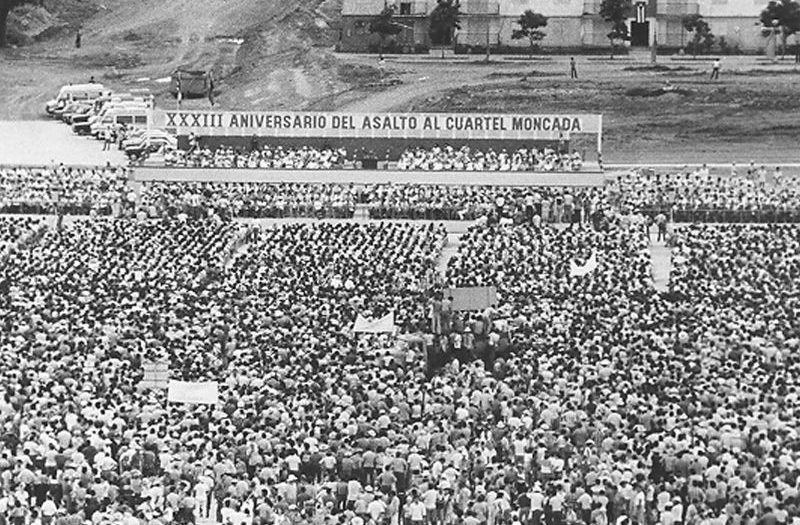
“I remember it with great joy; I am very glad to have been there and to have played a part in it all—to see everything go so well. Three hundred thousand people attended that event; it was a massive gathering with a tremendous turnout, and every municipality took part.”
Forty years have passed, yet Ernesto Rafael González Rodríguez remembers it as if it had happened yesterday. It was July 26, 1986. Sancti Spíritus was hosting—for the first time—the national commemoration of the anniversaries of the attacks on the Moncada and Carlos Manuel de Céspedes barracks.
At the time, he was serving as a member of the Executive Bureau of the Provincial Party Committee. Consequently, he experienced every moment up close, right from the start of the preparations. And that event was no mere gift to a province that had been established only a decade earlier.
“It had to be earned, and so it was earned through his efforts. There was no infrastructure here when this area became a province, so Joaquín [Bernal Camero, then First Secretary of the Party in the province] began working toward hosting the July 26th commemoration; he used to say that we couldn’t bid to host the event until the area had officially become a province. A province had to be built from the ground up, and Joaquín and Hondal played a major role in that. Well, actually, all the local agencies played a significant part in it, too.”
“Everything that was done was in preparation for the July 26th event. Eventually, the province made its bid for the commemoration because it had achieved impressive figures: production reached 55 million liters of milk, 55 million eggs, and 500,000 tons of sugar—a milestone Joaquín celebrated at a Provincial Party Committee plenum, noting that the Uruguay sugar mill had added a third tandem mill, making it the largest in the country.”
“Many projects were built: the paper mill, the Río Zaza dairy complex, a monument to Alberto Delgado, and a viewing stand at the site where Manuel Ascunce and Pedro Lantigua were murdered. Joaquín insisted it be built of concrete to ensure durability; he always used to say that ‘provisional’ solutions often became the most permanent ones—that things had to be done right, or not at all.”
With the province established and under development, there was every reason to vie for the honor of hosting the July 26th event. Joaquín Bernal Camero, then the province’s First Secretary of the Party, rallied the masses to the cause; instead of just one event, three were held—an undertaking pursued with great tenacity by Ernesto Rafael González Rodríguez, who was a member of the Provincial Party Committee’s Executive Bureau at the time.
“A rally was held, and Joaquín announced to the masses that the ‘26th’ [commemoration] was going to be launched there. He told them, ‘We have to earn this right now—let’s get to work,’ and he gave the people gathered there the guidelines on what needed to be done.”
“Look, I was absolutely exhausted. It was a round-the-clock effort. Joaquín started working on the event a year in advance; preparations covered everything—where everyone would stay, including the Central Committee members, the families of the martyrs, and the Moncada veterans (the event took place at Los Laureles). Joaquín would tell the organizing bodies: ‘You set up a hammock for them—there’s nowhere else. Just put up a hammock and that’s where they’ll stay, because there’s no other place to lodge them.’
But in the end, it turned out wonderfully.”
“I was responsible for preparing the event. There was a lot to be done. During the design phase, part of the speakers’ platform ended up positioned over the water cisterns. Raúl—Army General Raúl Castro Ruz—found out and arrived with Joaquín; there was a real fear that someone could plant a device in a cistern that might explode under the platform, or that the cisterns might break and flood with rainwater. It was finally resolved: Joaquín convinced Raúl to station people at specific points—wherever the cistern outlets were—to keep watch so the event could go ahead.”
“When the venue for the 26th was announced, an afternoon rally was called. It was incredible—people with flags, *tumbadora* drums, the *conga* band, and the *Septeto Espirituano*. The last person to leave was a Black man—I don’t know how he did it—who used to stick a small stick through his nose. I had to stay behind because I was with the propaganda unit, and we had to clear everything up.”
And on July 26, 1986, Sancti Spíritus hosted the national commemoration of the Moncada anniversary for the first time.
As I told you, 300,000 people came to that event—a tremendous turnout. During the ceremony, Fidel congratulated Joaquín and the province. There was an anecdote involving the clock on the 12-story building. Fidel heard the clock chiming and asked, “Are they timing me?” They told him no. Then he said, “Well, people need to be just as punctual as that clock at work—that’s what Fidel said.”
The 1986 national July 26th ceremony—an event Sancti Spíritus had earned the right to host—proved to be a pivotal moment in the life of Ernesto Rafael González Rodríguez, a man who, by his own admission, built his life in the spirit of the Revolution.
He had little opportunity for formal schooling; at age twelve, his father took him to work in the fields to help support the family. Yet, through that experience, he mastered life’s various lessons. Before him stands a bookshelf containing the works that were instrumental in shaping his character.
“Yes, I love to read; I’m always reading. Right now, I was reading *Todo el tiempo de los cedros* [All the Time of the Cedars]. I have Martí’s diary and a book given to me by Ramón Labañino—one of the ‘Five Heroes.’ He arrived one day at the home of a neighbor who was a friend of his and asked me, ‘Do you want to meet Labañino?’ So I went over. I spent a while talking with him, and the next day he knocked on my door, handed me the book, and inscribed it: ‘You are a friend of the Five Heroes.'”
“I am a product of the Revolution. I am very grateful for that. I was just a country boy back then; were it not for the Revolution, I’d still be out in the countryside—not that I mind the countryside; I like it—but I’d likely still be there with only a sixth-grade education.”
Ernesto Rafael González Rodríguez has dedicated 45 of his nearly 80 years to Party work, holding responsibilities ranging from the heart of the Escambray mountains in Topes de Collantes to directing the organization’s school and undertaking political missions in former socialist countries like the German Democratic Republic and Czechoslovakia. He cherishes the lessons and anecdotes from all those experiences.
He is an avowed admirer of Fidel and Faustino Pérez. Because of this, the spirit of that “26th of July” from forty years ago returns every summer to the most intimate setting of all: his own home.
“I am very grateful to the Party. The Party owes me nothing. I am the one who owes the Party and the Revolution. What I want most is for this to move forward and for us to avoid trouble; things are tough, as you know, but we have to keep going, and now it’s up to the new generations. I do what I can, and I keep going—we can keep doing our part.”
“This Sunday, I’ll be celebrating the 26th. I’ll watch the ceremony, put up a flag—the Cuban flag and the 26th of July flag—and that’s my *Sancti Spíritus* way of marking the date. It’s a spirit that shouldn’t die; if it does, it’s because we let it die.”