Rabbits, earth and resilience: life according to Edilia
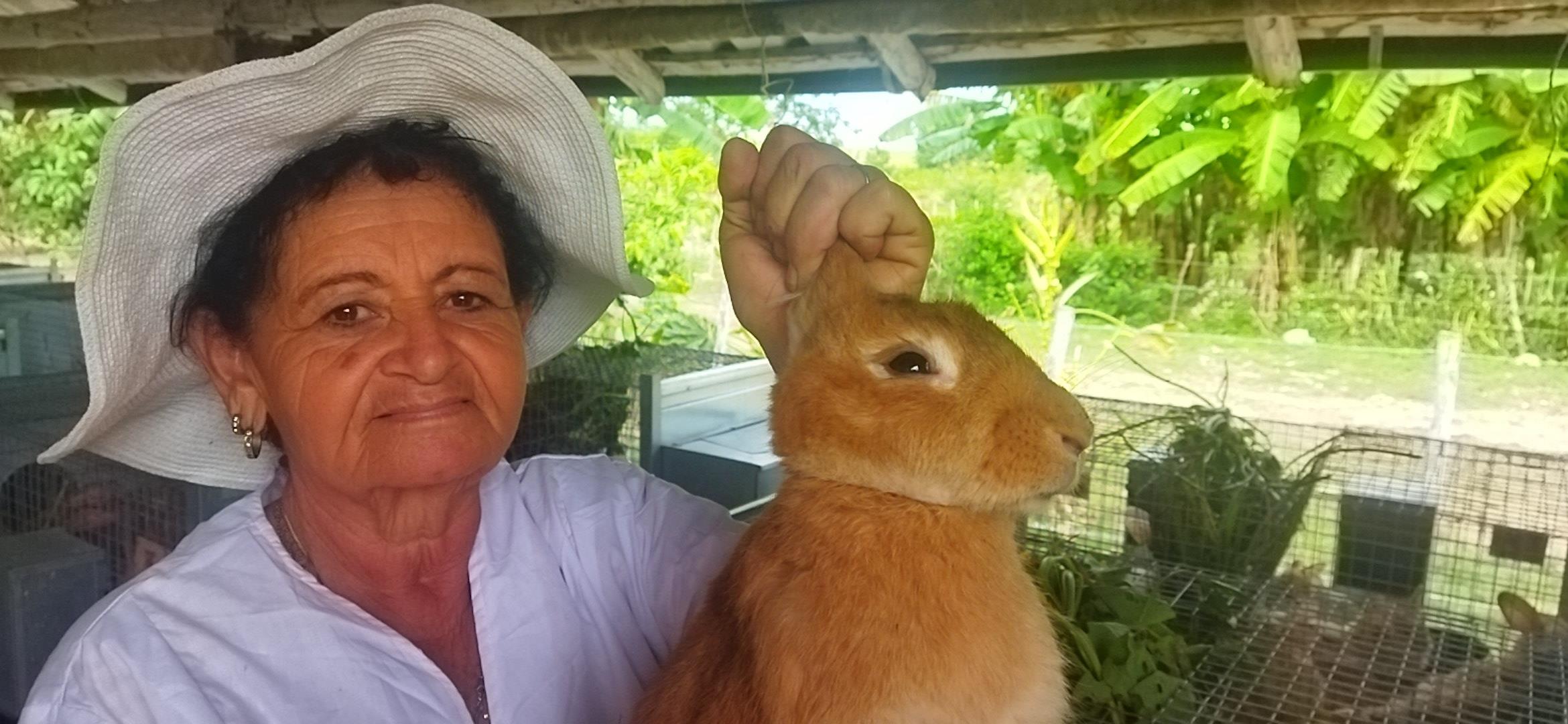
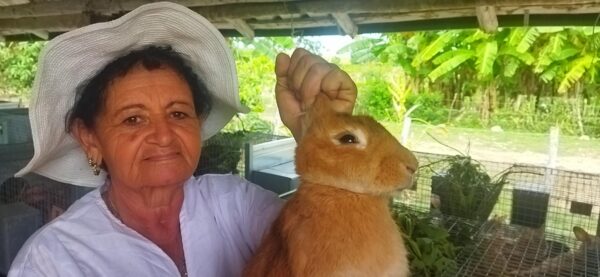
The first image of Edilia Linares Cala, at 60 years old, is not that of a woman defeated by time, but of someone who still believes in tenderness as a work method.
She enters the rabbit shed on the La Mulata farm in the Sancti Spíritus municipality of Taguasco and calls them in a homely tone, like someone waking up a child without any surprises. The ears move first; Then, the bodies appear. She smiles with the confidence of someone who knows that life, sometimes, responds better to softness than to shouting.
“If you love them, they calm down,” she says, while running his hand through the cage of a rabbit that he has named Carolina. Others are called Violeta, Isabel, Rosalí, la Patrona. Naming them, for Edilia, is not a whim: it is a way of giving them a shelter.
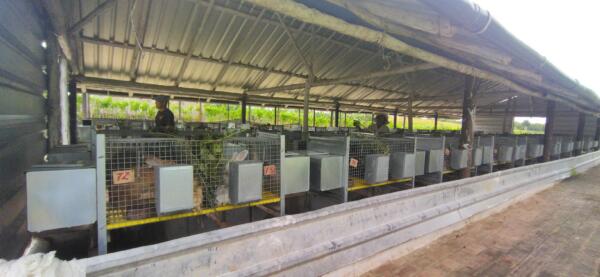
Before arriving at this place that completes her today, she had been through many places: house cleaner, culinary assistant, shop assistant, temporary worker as soon as the center appeared. I jumped from job to job like someone looking for a place in the world without finding it.
Her entry into La Mulata occurred almost by destiny. Edwin, the person in charge of the estate, knew her for her almost surgical discipline and her desire to leave everything sparkling. He called her when the project needed someone “right” to start the rabbit ship. Then they only had a few animals. Eight months later, they already exceed 150. It’s not a miracle, it’s work.
Edilia’s story is linked, although she does not say it, with the spirit of the National Program for the Advancement of Women, which is committed to economic autonomy, equitable access to employment and the recognition of female leadership in productive spaces. What appears in that document as a principle, here takes shape in a ship that smells of fresh hay and hope.
“I am from the countryside and I never left the countryside,” says Linares Cala. Maybe that’s where it all lies: La Mulata not only gave him a job; He gave him back his root.
The work that sustains your future

Sometimes Edilia thinks that rabbits understood her before people. “I arrive in the morning and call them and they know and recognize me,” she says with a mixture of pride and shyness, as if she were afraid of exaggerating the humanity of he animals. But the truth is that she looks at them with a delicacy that is difficult to find even among those who raise by family tradition.
She recognizes them by their gestures, by the speed with which they breathe, by the docility or harshness they show after mounting. Guess when a calf needs more heat, when a male lost appetite, when a female became too irritated. For her, parenting is not a procedure, it is a language.
This accelerated growth cannot be explained without another driver: the support of ALASS (Local Self-Sufficiency for Sustainable and Healthy Food), an international project that supports local, sustainable food systems with greater participation of women. Thanks to this alliance—which is part of the SAS-Cuba Program—in La Mulata they learned to plant king grass, sweet potato vine and cane; to prepare increased feed; to comply with vaccination schedules; to maintain hygiene standards that guarantee healthy animals.
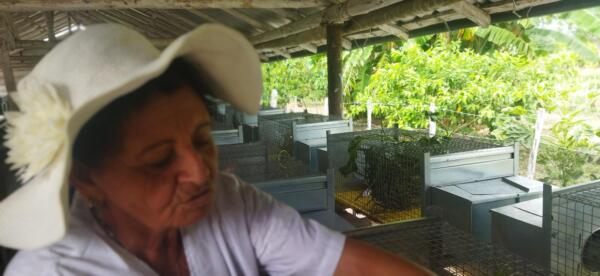
“Every third day I wash the vessels with water, detergent and chlorine. And I wipe the canoes where they sleep with a cloth every day so they don’t get damp,” she explains without presumption, as if describing the natural routine of someone who takes care of what they love.
This rigor is directly linked to the Law on Food Sovereignty and Food and Nutritional Security (SSAN), which promotes initiatives capable of supplying communities from their own territory, without depending on extensive or vulnerable chains.
The salary—10,000 pesos a month, 2,500 every Friday—means more than stability. For Edilia it is proof that her work matters. “In my house they are happy. My husband also likes the babies. We both support each other,” she explains.
And although it plays a determining role in the house, what defines it is not productivity, but the way in which it stirs inside when the natural cycle requires saying goodbye to an animal.
When the sacrifice comes, she cries. Sometimes she tries to hide it; It doesn’t always succeed. She hands over the rabbit with a brief tremor, as if giving up a part of himself. “It gives me a lot of pain… I have raised them since they were little,” he repeats. In that mix of efficiency and sensitivity—able to comply with a protocol, but without shielding the heart—lies the truth of his character.
When rabbits are tested
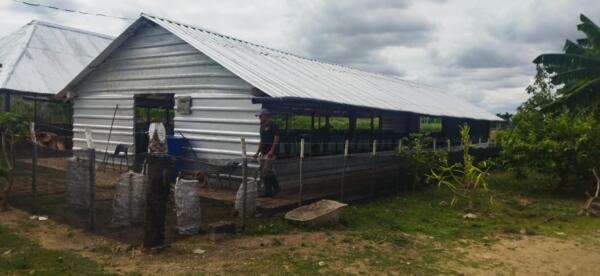
The woman from Taguasco remembers her first day on the ship as if she were remembering an initiation test. She had barely learned to open the cages when one of the males—a restless brown, with more nerve than size—sanctioned his teeth into his hand. The pain was dry, quick, so unexpected that for a moment she believed that this was not for her. She looked at the deep mark, the two purple dots that then swelled as if the animal wanted to leave a seal on it. “That day I told myself: either you go or you stay,” she says now, smiling at the scar that is almost indistinguishable.
Fortunately, she stayed, not out of stubbornness, but out of a mix of intuition and desire to establish roots. Since then, scares have been part of the job: scratches when changing canoes, bites from protective rabbits when they stop, unexpected jumps that hit her in the chest. She takes it with humor. “If they don’t bite me, it’s not a full day,” she jokes.
That first pain, however, made her understand something essential: that the earth and its creatures usually test people before accepting them. Edilia passed the test as she passes everything that life has put before her: without noise, without complaint, with a silent temper that strengthens every time she enters the ship and calls them as if she still needed to convince the field that she is already part of it.
A woman who beats to the rhythm of the earth.
Edilia doesn’t talk like a heroine. She speaks like a woman who has worked her entire life. She sums it up with a phrase that deserves to be engraved at the entrance to any farm: “There is no work that a woman cannot do in the countryside if she does it with love.”
And she backs it up with facts: she was the first female head of farm 225 in the rural community of San Marcos, a time when she planted crops, rode horses, organized brigades, and took care of animals. He defended, even then, that the field does not distinguish between men’s and women’s tasks; distinguishes between those who have will and those who do not.
Today La Mulata is not just a job: it is a setting where her experience once again has weight, where her name matters, where her story finds a natural channel.
She says he misses the rabbits when he goes home. That Violeta, her favorite, “gives very beautiful offspring.” That the countryside is “the most beautiful thing that could have happened to me.” And in this trilogy of affections—attachment to animals, pride in their offspring, inevitable love for the land—the intimate meaning of their existence is drawn.
Theirs is not an epic ascension, but a daily conquest: a way of being in the world.
Her life is the sum of many rural lives that today, thanks to sustainable projects and inclusive public policies, are beginning to find recognition. And yet, she has a particular light: that of someone who rebuilt himself without giving up tenderness.
In Taguasco, among clean cages, sweet potato vines and tame rabbits, Edilia Linares Cala demonstrates that autonomy is not proclaimed: you work with perseverance, with dirt under your nails, with faith in what you raise. And that each woman—if she finds the right place—can build her own interior farm.